A printable mystery, made for your table
Make your own mystery game, then print it and play.
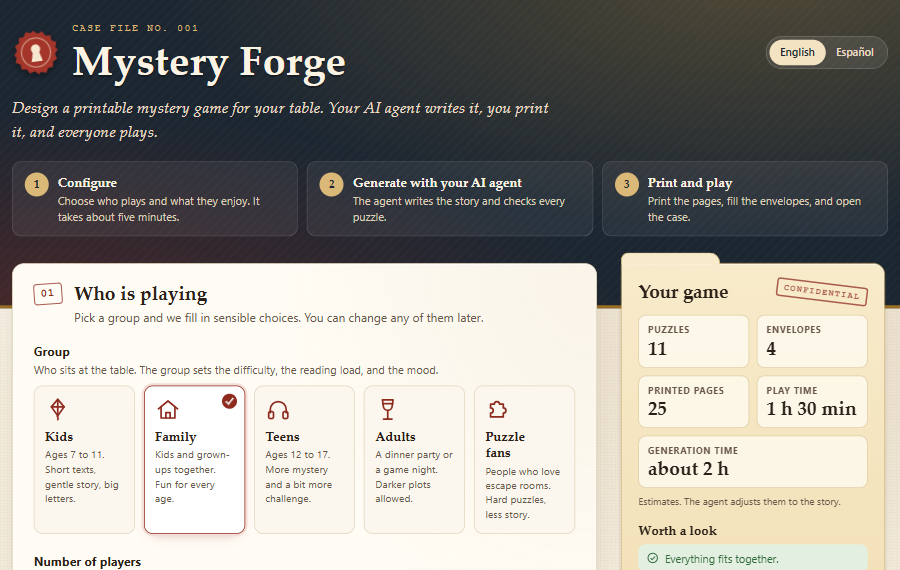
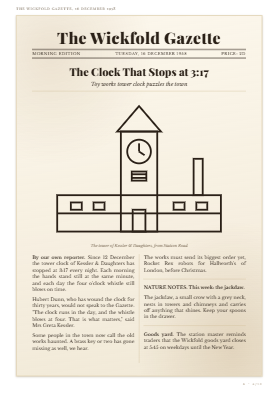
You choose who plays, how long it lasts, and the language. An AI writes a new story with suspects, clues, and puzzles, tests it, and gives you files to print. You play with paper, pencils, and envelopes.
Free and open source. You need Windows or macOS and a paid Claude account.
How it works
-
Download and unzip
Get the ZIP file and unzip it, for example into your Documents folder.
-
Double-click "Start Mystery Forge"
The first time, it installs what it needs by itself. Then it shows a short menu.
-
Choose your game
Pick the players, the length, the language, and the story. The AI makes the game in about 1 to 2 hours.
-
Print and play
Open the file whose name starts with "1 -". It tells you what to print and how to set up the envelopes.
What you need
- A computer with Windows or macOS.
- A paid Claude account (Claude Pro or Claude Max). The AI that writes the game runs on it. One game uses a large part of what your plan allows in a few hours.
- Google Chrome or Microsoft Edge, to turn the game into PDF files.
- A printer. Black and white is fine.
What you get
- A manual with the printing checklist, the setup, and the rules.
- The game materials, split into envelopes, with an answer list and an accusation form.
- Hint cards and solutions, in a folder that warns about spoilers.
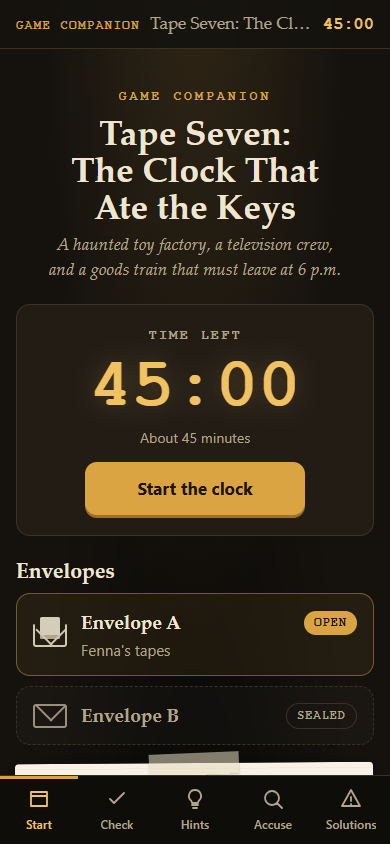
- A companion page for a phone, which works offline.
Any language, any table
A game can be in any of 50 languages. English, Spanish, Catalan, French, German, Italian, and Portuguese have hand-checked texts; for other languages, the AI translates the fixed texts for each game. Games exist for kids, families, teens, adults, and puzzle fans, for one player or for a party.
How the games stay correct
- Code builds the puzzles that code can build, so they are correct by construction.
- Code checks the whole game: every clue comes from a real document, no answer shows up too early, and the game fits the time that you chose.
- AI test players get only what real players have and try to solve each puzzle. A puzzle that is too hard, or that has two good answers, goes back for a fix.
Ready to make a game?
The step-by-step guide on GitHub explains every click, also for people who never used a terminal.